Home / Power, chargers and cables
Power banks: mAh versus Wh, and what airlines allow
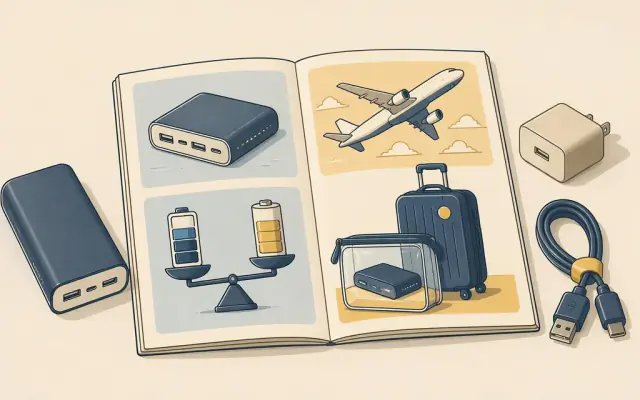
Power banks are sold by milliamp-hours (mAh), but airlines and safety rules use watt-hours (Wh). If you understand the difference, you can compare power banks honestly and know before you get to the airport whether yours is allowed on board.
mAh is only half the story
Milliamp-hours measure charge, not energy. To know how much energy a battery holds, you also need its voltage. Power banks list the capacity of their internal cells, which run at about 3.6 to 3.7 V. Your phone or laptop charges at 5 V or more, and converting between voltages loses some energy as heat.
How to convert mAh to Wh
Use this formula:
Wh = mAh × V ÷ 1000
For a typical lithium-ion cell at 3.7 V:
| Capacity | Energy | Airline status (typical) |
|---|---|---|
| 5,000 mAh | 18.5 Wh | Allowed in the cabin |
| 10,000 mAh | 37 Wh | Allowed in the cabin |
| 20,000 mAh | 74 Wh | Allowed in the cabin |
| 26,800 mAh | about 99 Wh | Allowed in the cabin, just under the limit |
| 40,000 mAh | 148 Wh | Airline approval needed |
Most power banks print the Wh figure on the case. If yours does not, use the formula with the voltage shown on the label.
Airline rules in brief
Rules come from international aviation safety guidance followed by most airlines and authorities. They broadly say:
- Power banks and spare lithium batteries must go in the cabin, never in checked luggage. A fire in the cabin can be spotted and dealt with; a fire in the hold cannot.
- Up to 100 Wh: allowed in carry-on luggage without approval.
- Over 100 Wh and up to 160 Wh: allowed only with the airline's approval, usually limited to two spare batteries per person.
- Over 160 Wh: not allowed as spare batteries on passenger aircraft.
Many airlines add their own rules, such as not charging devices from a power bank during the flight, keeping the power bank visible rather than in the overhead bin, or limiting the number you carry. Since 2025 several airlines have tightened these rules, so check your airline's current page before every trip.
How much charge will you really get?
Expect roughly 60 to 70 percent of the rated capacity to reach your device, because of voltage conversion and heat. A 10,000 mAh power bank typically recharges a modern smartphone with a 4,500 to 5,000 mAh battery about one and a half times, not twice.
Choosing a power bank
- 10,000 mAh for daily carry and short trips; small enough for a pocket.
- 20,000 mAh for travel days and charging several devices.
- About 25,000 mAh (just under 100 Wh) for laptops, if it supports 45 to 100 W USB-C Power Delivery output.
- Check the output wattage, not just the capacity. A large power bank that only provides 18 W will charge a laptop very slowly, if at all.
- Look for clear Wh labelling and recognised safety marks; airport staff may refuse an unlabelled battery.
Caring for power banks
Store power banks partly charged if you will not use them for months, keep them out of hot cars and direct sun, and stop using any that swell, smell or get unusually hot.
For pairing a power bank with the right charger and cables, see GaN chargers explained and the one-bag tech kit.