Home / Power, chargers and cables
Power, chargers and cables
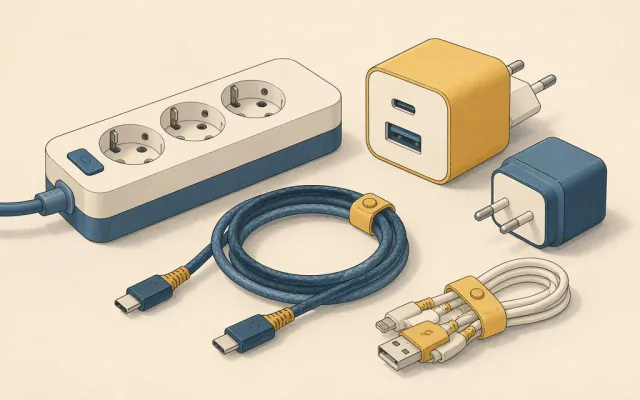
Almost every small gadget now charges over USB-C, which should make life simple. In practice the same connector hides very different capabilities: a cable can carry 15 watts or 240, move data at USB 2.0 speed or 40 gigabits per second, and a charger can quietly slow down when two devices share it.
These guides explain GaN chargers, the difference between mAh and Wh on a power bank (and why airlines care), why USB-C cables are not all the same, and how USB Power Delivery decides how fast a device charges.
Guides in this section
GaN chargers explained
What gallium nitride does in a charger, how to size a multi-port model, and how power is shared between ports.
Power banks: mAh versus Wh, and what airlines allow
Why watt-hours matter more than milliamp-hours, how to convert between them and the cabin limits that apply on flights.
Why USB-C cables are not all the same
Charging watts, data speed and video support differ between cables that look identical. How to read the markings and buy the right one.
USB-C Power Delivery wattage explained
How a USB-C charger and a device agree on voltage and current, what the PD levels mean and why a device charges slower than expected.